

Please click here to open the map which will guide you towards the 4 most iconic areas in Palermo for its street art.
Discover This Month's Featured Paintings
The paintings exhibited in the apartment
Below you will find the artist’s details and a description of the works.

Il Genoardo – Paradise on Earth
June, 2026
Acrylic on canvas Giovanni Albanese
The work depicts ‘La Cubula’ (also known as ‘Piccola Cuba’), an elegant 12th-century pavilion in Palermo, once part of the lush Genoardo Royal Park. The work is not merely an architectural record, but a poetic narrative of the Sicilian landscape. The artist succeeds in capturing the stillness of a sun-drenched afternoon, where the silence of history blends with the lush natural surroundings. It is a tribute to Palermo, the ‘Paradise on Earth’, capable of evoking the splendour of the times through a colour palette that highlights the Mediterranean identity

Blooming Pad (Available in different sizes)
June 2026 Acrylic on canvas
Giovanni Albanese
In this work, the artist employs a contemporary expressionist style, transforming the resilience of the prickly pear into an explosion of vibrant colour. The painting is not merely a botanical depiction, but a metaphor for resilience. The prickly pear, a plant capable of thriving in adverse conditions, is celebrated here in its flowering phase, symbolising the beauty that springs from strength and tenacity. The isolation of the subject against the ethereal background accentuates its iconic quality, transforming a desert plant into a portrait of pure existential energy.

Countercurrent Pads (Available in different sizes)
June 2026 Acrylic on canvas
Giovanni Albanese
In this work, the artist captures the essence of the Mediterranean landscape through a visual synthesis that oscillates between naïve realism and textural expressionism. The work is dominated by the central figure of the prickly pear, a plant symbolising resilience and vitality. The plant is anchored to a cliff rendered with thick brushstrokes and earthy tones, creating a stark textural contrast with the ethereal blue expanse of the sea in the background. The prickly pear, with its roots that seem to defy the bare rock, becomes a metaphor for Mediterranean identity: a beauty that is rugged and thorny on the outside, yet capable of thriving in extreme conditions and offering unexpected sweetness. The work does not seek academic perfection, but aims to convey a sense of belonging and tenacity, evoking the power of nature set against the infinity of the sea.

Contemplative Rhythm (Available in different sizes)
June 2026 Acrylic on canvas
Giovanni Albanese
In this work, Giovanni Albanese strips the landscape back to its most essential form, transforming it into a space of memory and contemplation. The undulating hills, punctuated by a few slender trees, do not depict a real place, but evoke an inner landscape, suspended between memory and imagination.
Albanese does not seek descriptive realism, but rather a poetic synthesis of the landscape, where colour takes on an expressive value of its own and nature becomes a metaphor for tranquillity, time and permanence. The result is an image of great visual immediacy that invites the viewer to slow down their gaze and rediscover, in the simplicity of the forms, a sense of timeless harmony.
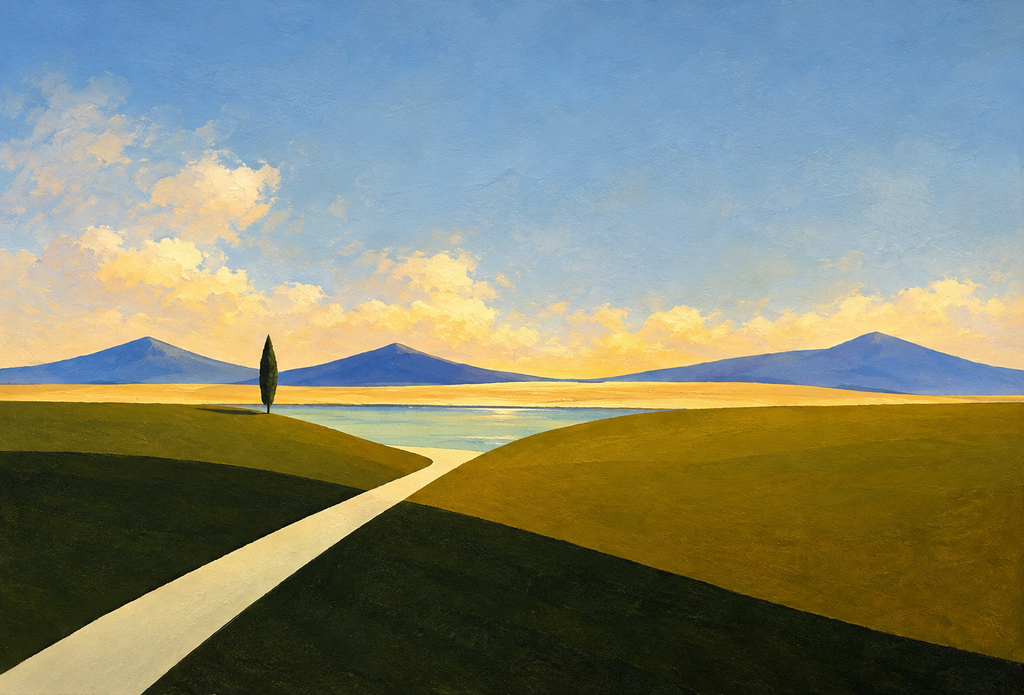
Dimensions of Stillness (available in various sizes)
February 2026
Giovanni Albanese
A minimalist landscape constructed through fields of colour and an open perspective. A path winds through the dark earth and leads toward a body of water, while a single cypress tree marks the transition between human space and the immensity of the landscape. The golden light of the horizon introduces a suspended dimension, transforming the scene into a meditation on travel, distance, and the possibility of an elsewhere. The path takes you by the hand. It starts from the lower edge of the canvas, right where you are standing, and leads toward the water and the horizon. It doesn’t end at a specific point, though: it fades into the landscape. The painting doesn’t tell you where to go. It invites you to go there.
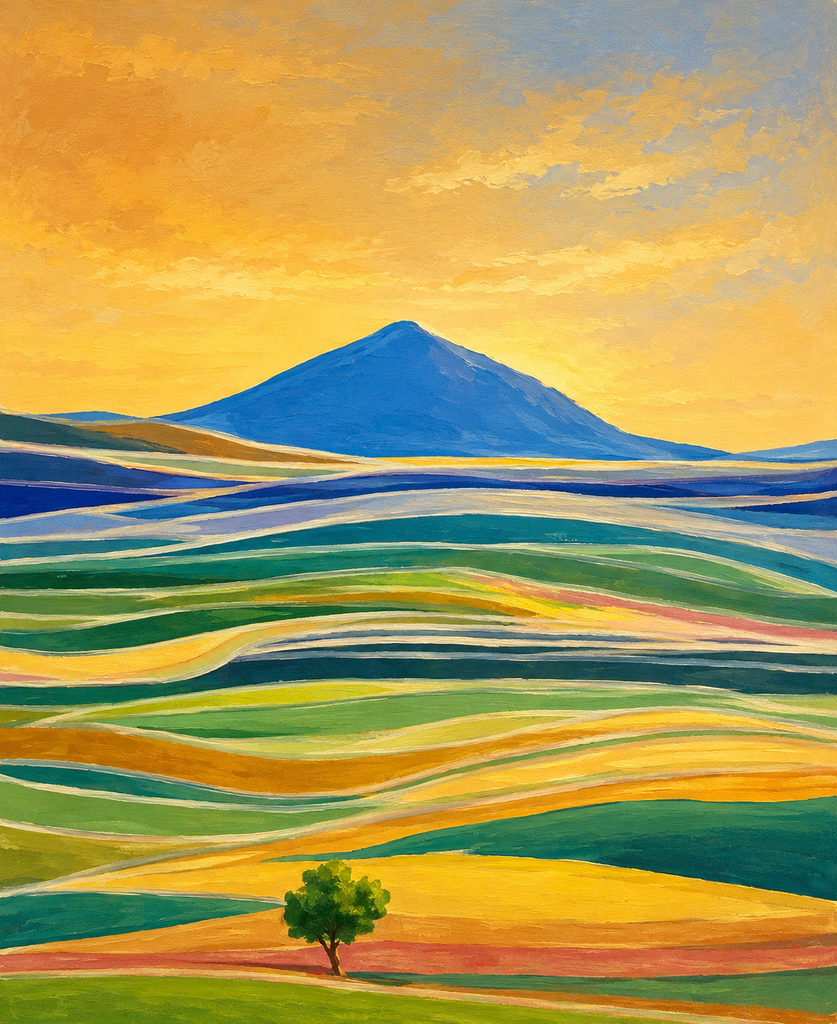
Distant Admiration (Available in different sizes)
February 2026 Acrylic on canvas
Giovanni Albanese
The mountain is not a naturalistic depiction: it is almost a symbol, an archetypal form. But precisely for this reason, it becomes the emotional center of the work. It is still, silent, almost monumental, while everything in front of it—the fields, the roads, the bands of color—seems to be moving. The horizontal lines curve, overlap, and cross the canvas like waves. The green, yellow, turquoise, ochre, and pink do not simply depict the countryside: they transform it into a sort of musical landscape. Look at the small tree in the foreground. It is deliberately out of proportion to the vastness of the landscape. It isn’t there to depict a tree. It’s there to provide a sense of scale for the entire scene. And suddenly, the viewer finds themselves facing an enormous expanse. What’s fascinating is that the tree isn’t in the center. It’s off-center, almost marginal, and from a distance, one is captivated by so much beauty.

The Sea at Palermo in Autumn (Available in various sizes)
March 2025 Acrylic on canvas
Giovanni Albanese
The work thrives on a radical chromatic polarization that delineates two moods and two compositional weights. The work falls within that fringe of geometric abstraction that does not abandon the suggestion of reality (the seascape), but reduces it to its primordial elements: line, colour, surface, and texture. The painter, Giovani Albanese demonstrates that pictorial space can be organized with the same precision as a living space, transforming the horizon into a central element of the imagination.

The Sea of Palermo in Spring (available in various sizes)
June 2025 Acrylic on canvas
Giovanni Albanese
Albanese achieves a perfect balance between the lyricism of the landscape and the rigor of geometric abstraction. The work functions as a perfect architectural scheme: heavy foundations (yellow), an intermediate layer of contrast (blue), and an immaterial roof (the neutral sky). It demonstrates how nature can be painted not by copying its forms, but by applying the laws of statics and proportion to it.
The strength of Giovanni Albanese’s painterly exploration lies in this ability to conceptualize the landscape. He strips the Sicilian seascape of every anecdotal detail (boats, rocks, figures) to isolate its skeletal structure: the horizontal line, the density of the water, and the thermal energy of the sun. It is a refined abstraction that never loses touch with the earth and the light of its own identity.

The Sea of Palermo in the Summer (available in various sizes)
June 2025 Acrylic on canvas
Giovanni Albanese
In this painting, Albanese draws closer to the artistic explorations of the Colour Field Painting and the rigor of the masters of 20th-century abstraction, but he infuses it with a distinctly Mediterranean light. It is no longer a description of a place, but a geometric synthesis of its thermal and luminous energy. The architect has stopped drawing space and has begun to quantify it in terms of color intensity.

Glimmers (available in various sizes)
May 2025 Acrylic on canvas
Giovanni Albanese
In this work, Albanese demonstrates an expressive maturity that goes beyond mere geometric rigor. The artist succeeds in capturing the warmth of the Sicilian coast and the vastness of its sea by eliminating the superfluous, allowing the vibrancy of color to convey the sense of space.

Faces and Masks (available in various sizes)
2023 Acrylic on canvas
Giovanni Albanese
The artist employs a visual language characterised by flat, saturated colour fields, reminiscent of advertising graphics and modern illustration. In this work, the chromatic decomposition is not merely an aesthetic choice, but a tool for exploring contemporary identity. The image transforms the individual portrait into a universal icon, where the mask of colour and form invites the viewer to question the surface and what lies beneath the vividness of appearances.

Faces and Masks 2 (available in various sizes)
2023
Acrylic on canvas Giovanni Albanese
In this work, we are presented with a vibrant celebration of the Pop Art style, reinterpreted through a contemporary sensibility that plays with the geometric decomposition of the face. This painting is not merely a portrait, but an explosion of modern energy. It captures the essence of contemporary beauty — stylised, iconic and expressive — transforming an anonymous face into a symbol of chromatic power. It is a work that asks for no permission, but asserts itself in the space with absolute chromatic confidence.

Faces and Masks 3 (available in various sizes)
2024
Acrylic on canvas Giovanni Albanese
This work presents itself as a vibrant explosion of contemporary Pop Art, a close-up portrait that challenges the viewer through a bold, almost psychedelic use of colour. It is a piece that blends the aesthetics of digital media with traditional painting, resulting in a powerful, energetic image with a strong decorative impact.

Home in the countryside (available in various sizes)
2008 Acrylic on canvas
Giovanni Albanese
No need for hyperrealism, but instead there is a need for stability and domestic warmth. The painting’s strength lies in its ability to transform an everyday corner into a space for tactile and chromatic contemplation.

Look Beyond (Available in different sizes)
June 2026 Acrylic on canvas
Giovanni Albanese
Acrylic – There is a kind of lyrical minimalism in this painting. The use of coarse-textured canvas, left visible beneath the paint layer, lends the work a tactile authenticity. There is no attempt at photographic realism, but rather a desire to capture the emotion of light.
The tree is not merely a plant, but a symbol of vitality that emerges powerfully from an abstract and orderly space. It is a work that conveys a sense of radiant calm and contemplative solitude.
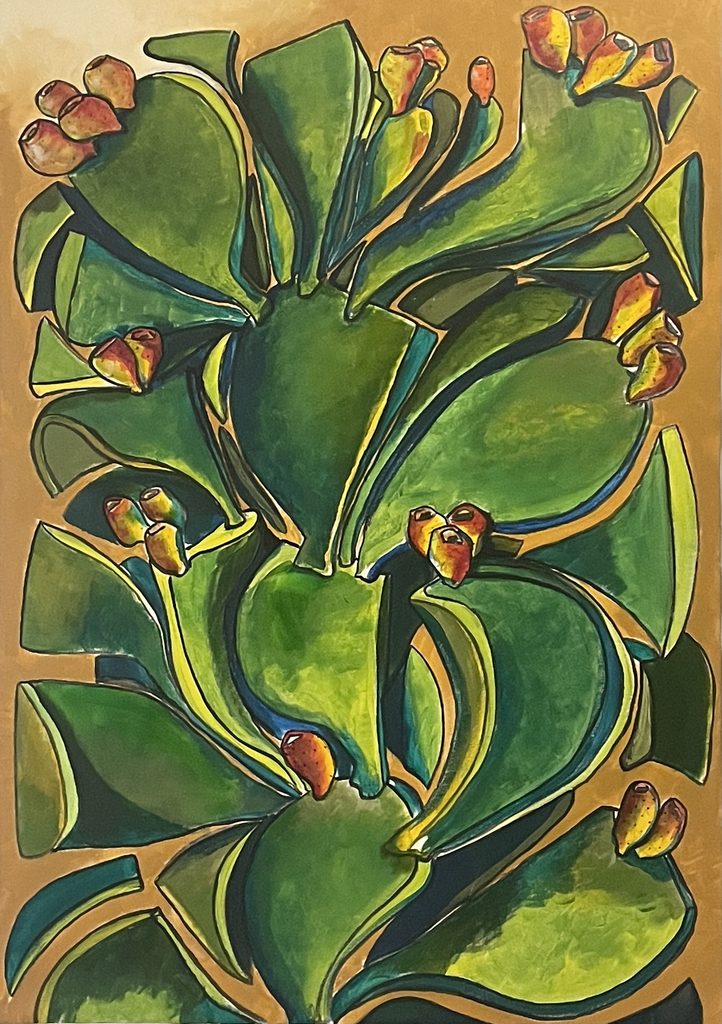
Sicilian Warmth (Available in different sizes)
April 2025 Acrylic on canvas
Giovanni Albanese
The ochre-colored background plays a fundamental role. It immediately evokes the warm light of the Mediterranean, the sun-scorched earth, and the golden walls of Southern Italian architecture. The prickly pear, a plant deeply rooted in the Sicilian landscape, thus becomes more than just a botanical subject: it becomes a symbol of belonging to the region, expressed through a modern pictorial language.
There is also something almost totemic about the vertical arrangement of the plant. The leaves seem to rise, open up, and multiply, while the fruits introduce a sense of abundance and vitality. The result is an image that conveys resilience, fertility, warmth, and life.
The prickly pear is not merely a feature of the landscape, but a symbol of nature that endures, grows, and continues to bring forth life under the intense Mediterranean sun.

First Impressions (available in all sizes)
2019 Acrylic on canvas
Giovanni Albanese
Acrylic on paper – The painting does not merely depict an element of the Mediterranean landscape, but celebrates its vital force and intrinsic geometry. It is a work that conveys solidity and freshness, capable of modernising a traditional symbol through a clean graphic sensibility and a vibrant use of colour. The work features a dense, vertical composition, in which the prickly pear pads (cladodes) overlap, creating a dynamic rhythm that almost entirely fills the canvas. The decision to frame the plant so tightly eliminates the horizon line, transforming the natural subject into an almost abstract pattern. The bold, decisive contour lines not only serve to define the shapes but also act as a veritable graphic framework that lends solidity to the composition.

Dancing Nature (available in all sizes)
2022
Acrylic on paper Giovanni Albanese
This work immediately captivates with its vibrant reinterpretation of the prickly pear, transforming an iconic element of Mediterranean flora into an almost architectural and dynamic composition. The structure unfolds vertically with an almost dancing rhythm. The leaves are not arranged statically, but seem to interlock and reach upwards in a swirling motion. The arrangement of the fruit adds a syncopated rhythm, guiding the viewer’s eye along the sinuous edges of the shapes.

Persistency in life (available in all sizes)
2020
2 x 3 m Oil on plywood Giovanni Albanese
This imposing two-metre-by-two-metre panel commands the viewer’s attention with the primal power of the Mediterranean landscape, transforming the wooden panel into a textural window that vibrates with light.
The choice of wood as a base is no accident: its natural grain seems to interact with the rough texture of the plant itself. The earthy, ochre tones at the base and on the right-hand side anchor the composition, suggesting a mineral presence that balances the organic vitality of the prickly pear. The graphic element in the bottom right-hand corner — a minimalist mark reminiscent of a letter or an archaic symbol — adds a layer of mystery, suggesting that this is not merely a botanical exercise, bbut a reflection on identity and the persistence of life in extreme conditions. In this illustration, the sheer scale of the image amplifies the poetry of the humble. The artist succeeds in elevating a common plant, transforming it into a totemic structure. It is a work that does not merely depict nature, but showcases its tenacity, filtered through a contemporary sensibility that favours chromatic synthesis and the expressive power of the line.

Unconditional love (available in all sizes)
2022 Acrylic on canvas
Giovanni Albanese
The work succeeds in stripping the sacred subject of all its Baroque embellishments to reveal its essence: an archetype of universal love. Its modernity lies not only in its style, but in its ability to make the divine accessible, human and vulnerable through a formal synthesis of great elegance.

An unbridgeable distance (available in all sizes)
2008 Acrylic on canvas 2 x 1 m
Giovanni Albanese
This painting, measuring an impressive 2 x 1 metres, is a modern, minimalist reinterpretation of one of the most iconic details in the history of art: the meeting of God’s and Adam’s hands in Michelangelo Buonarroti’s fresco *The Creation of Adam*. The focal point of the painting is the small gap between the two fingers, which never quite touch. This stylistic choice is rich in symbolism:
- The Spark of Life: It represents the moment immediately preceding creation, full of tension and anticipation.
- Free Will: This separation suggests that God leaves man free to choose whether or not to draw closer to the divine.
- An Unbridgeable Gap: It highlights the difference between divine perfection and human finitude.
Measuring 2 metres in width, this painting is designed to be a striking piece of décor, capable of transforming a room with a classic aesthetic given a modern twist.

La Conca d’Oro (disponibile in vari formati)
2020
Acrylic on canvas Giovanni Albanese
The work is dominated by a central symmetry that lends the composition an almost monumental and iconic aura. The trunk, rendered with visible vertical brushstrokes that suggest the grain of the wood, serves as a solid axis for a dense and luxuriant canopy. The rounded shape of the foliage fills the space with a restrained vitality, typical of certain modern still lifes that seek order within organic chaos. The painting technique exhibits a certain textural quality, with short brushstrokes that lend volume to the individual leaves. This style is reminiscent of contemporary works that play on the repetition of natural patterns, as seen in artists who explore the theme of fruit trees from a modern perspective. In short, the work conveys a sense of serenity and abundance, transforming a simple subject into an almost regal portrayal of nature.

Testimony
May 2026 Acrylic on a wooden beam
Giovanni Albanese
This is a work that celebrates the beauty of imperfection. The artist’s hand does not seek the millimetre-perfect precision of industrial production, but rather the vitality of the human touch. It is a piece that exudes history and a sense of place, capable of transforming the humble nature of recycled materials into a rich testament to Mediterranean visual culture.

The courtyard of Villa Albanese
2008
Acrylic on canvas Giovanni Albanese
This painting, signed ‘Albanese 2008’, presents itself as a work with an evocative naïve style, characterised by a clean formal composition and meticulous attention to detail that evokes the ethereal atmospheres of magical realism. Natural elements, such as the palm trees that seem to ‘emerge’ from the roof or the flowering climbing plants on the right, are rendered with almost calligraphic precision. This style, despite its apparent simplicity, conveys a profound sense of order and harmony. The absence of human figures emphasises the contemplative nature of the painting, transforming a rural courtyard into a quiet, sheltered sanctuary for the spirit.
In short, the Albanese artist succeeds in elevating an everyday scene through a poetic vision and meticulous technique, presenting us with an image that is at once familiar and dreamlike.